
Hiriya Recycling Park – Israeli Innovation in Waste Management
About the Dan Region Association of Towns for Sanitation
The Dan Region Association of Towns for Sanitation operates Hiriya Recycling Park – Israel’s leading facility for advanced municipal waste treatment. Every day, approximately 4,000 tons of waste are received at the site from over 25 local authorities in the Greater Tel Aviv area, including member municipalities such as Tel Aviv-Yafo, Holon, Ramat Gan, Bat Yam, Bnei Brak, and Givatayim, as well as other surrounding cities and private contractors.
The Association leads a significant environmental shift in Israel’s waste treatment sector, with key goals that include:
- Efficient and improved municipal waste treatment services for local authorities.
- Development of the Recycling Park, including sorting and separation facilities for recycling and waste-to-energy processes.
- Partnership in the rehabilitation of the Hiriya landfill and resource recovery from its buried waste.
- Promoting public dialogue and social change through the Environmental Education Center.
From Landfill to Advanced Waste Treatment
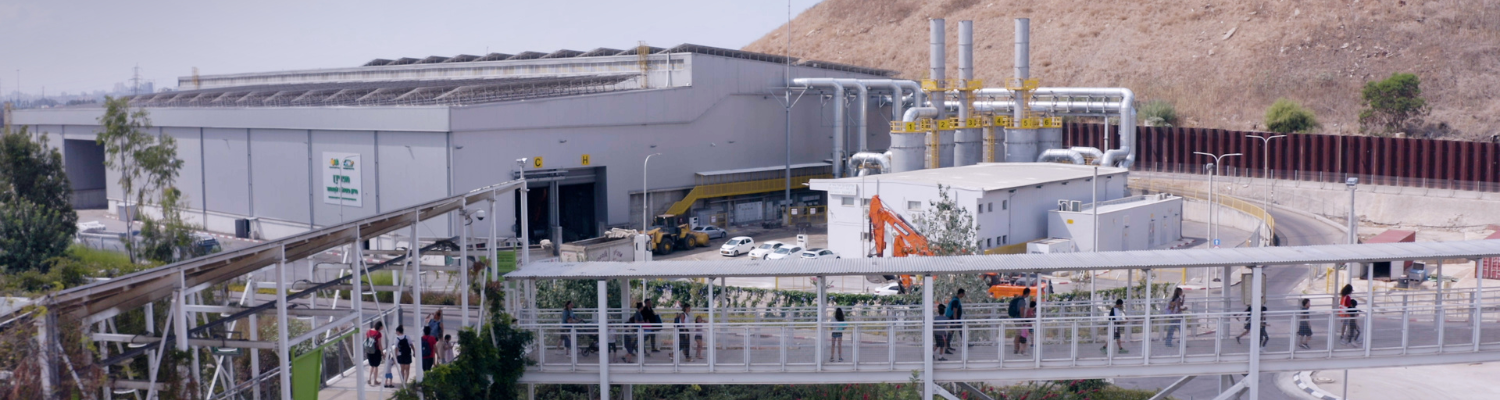
Since the closure of the Hiriya landfill in 1998, the Association has led a comprehensive environmental and planning transformation. A modern industrial park covering approximately 180 dunams (45 acres) was established.
Today, the park processes roughly a quarter of the municipal waste generated daily in Israel, channeling it to sorting, recycling, and energy recovery operations.
Active Facilities at the Site:
- Waste Transfer Station – Opened in 1999 and upgraded in 2022, it was renamed “Mafridan” as a prelude to the advanced separation facility currently under construction, set to open by the end of 2026. The station handles about 1,500 tons of waste daily. The waste is compacted and transported for landfilling at the “Afeh” site, about 100 km south of Hiriya.
- RDF Plant (Refuse-Derived Fuel) – Operating since 2017, this facility processes approximately 2,000 tons of mixed municipal waste per day. It sorts the waste, sending organics to biological stabilization, metals for recycling, and uses the remaining waste to produce alternative fuel for the cement industry.
The RDF plant is a model for generating energy from non-recyclable solid waste. It replaces polluting fossil fuels, reduces emissions, and helps divert waste from landfills.
- Construction Waste Recycling Facility – Established in 2022, this facility handles thousands of tons of construction waste monthly.
- Green Waste Treatment Facility – Established in 2000. This facility sorts bulky yard waste, sends large electronic waste for recycling, and grinds the organic material for composting and soil cover.
- Advanced Monitoring Infrastructure – An operational control system that tracks waste flows and vehicle movements.
- Solar Energy – Photovoltaic panels installed on facility rooftops help reduce reliance on fossil fuels.
Methane Gas from the Hiriya Landfill – From Waste to Electricity
The landfill rehabilitation project includes a unique system for collecting methane gas emitted from underground organic decomposition. This gas was previously used to generate energy at a nearby facility. The project earned recognition from the United Nations under the Clean Development Mechanism (CDM) – a groundbreaking international environmental initiative.
The Environmental Education Center – Raising Awareness, Creating Impact
Alongside industrial operations, the Hiriya Environmental Education Center—Israel’s largest of its kind—operates on-site. Established in 2007 in a restored historic building, the center hosts approximately 125,000 visitors annually.
It offers tours, workshops, and enrichment programs for students, professionals, security forces, and educators. Topics include sustainability, consumption reduction, and eco-conscious living.
Café Hiriya – Sustainability with a Social Mission
Located on the center’s campus, Café Hiriya is a social-environmental initiative run by the nonprofit organization “Shekulo Tov”. The café employs individuals with employment barriers, who are being provided with professional training and rehabilitative support.
The café operates on sustainable principles: reusable dishware, independent organic waste composting, and reduced ecological footprint.
Looking Ahead – Advancing Toward Comprehensive Solutions
The Association continues to expand Hiriya Recycling Park and promote new initiatives:
- Establishing a new mixed municipal waste sorting facility (“Mafridan”)
- Constructing an upgraded green waste treatment facility
- Building a packaging waste sorting plant in collaboration with T.M.I.R.
- Developing a facility for energy recovery from non-recyclable waste
- Connecting methane gas from the landfill to a generator for electricity production
Hiriya – A Pillar of the National Recycling System
Hiriya Recycling Park, led by the Dan Region Association of Towns for Sanitation, processes roughly a quarter of Israel’s municipal waste each day.
The park represents a long-term environmental vision: responsible and modern waste treatment, promotion of recycling and energy recovery, active public engagement on waste and consumption, and the cultivation of broad environmental awareness to shift consumption habits and daily behaviors.